100kVA genset planning: build the load schedule and starting sequence
Considering a 100kVA genset rental or purchase with Kyusen in Puchong? Start with the equipment you need to power, location and dates. This guide helps you prepare running loads and starting events, compare documented rating bases and request an assessment of the actual unit and package.
Planning a project?
Share the job, location and dates. Add the hire period if renting.
You can enquire before choosing a model. Technical details can follow.
Start with what you know about the load
You can start a genset rental or purchase enquiry with the job, location and dates before completing the technical worksheet. State whether 100kVA is a project requirement or only a starting point for discussion. Choose Not sure yet where details are missing rather than guessing a rating.
- You have equipment names or photographs: attach them, then use the load schedule to collect the relevant nameplate and manual data.
- You have a specified capacity or proposed model: attach the specification, including frequency and duty, and read the electrical rating before comparing candidates.
- Equipment starts or restarts automatically: describe those events alongside the running loads; use the restart example to show the information needed.
Comparing other genset sizes? The Kyusen genset rental range guide covers Airman, Denyo and Texas 1000kVA references. A catalogue capacity is a discussion point; the supplier and responsible electrical team still need to assess the complete load and duty.
Read the electrical rating, not the engine number
For a 100kVA genset, distinguish apparent electrical power in kVA from real electrical power in kW. Cummins gives the relationship kW = kVA × power factor. Power-factor reference
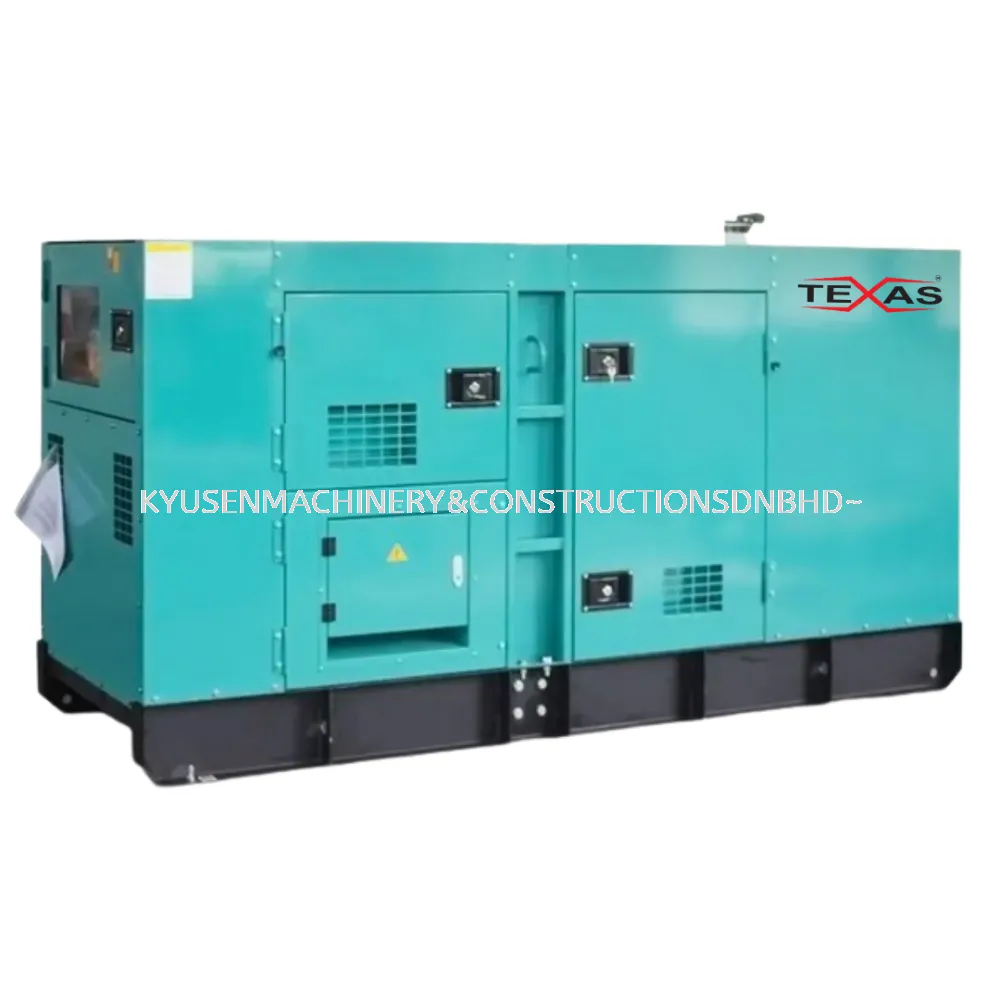
Kyusen’s Texas catalogue states 100kVA prime, 110kVA standby, 0.8 power factor, 400V, three phase and 50Hz. For the stated prime rating and power factor, 100 × 0.8 = 80kW is the associated real-power figure. This is a calculation from those catalogue fields, not a guarantee that every 80kW load will start or that every 100kVA machine has the same specification. Texas catalogue
The same catalogue separately lists 92kW at 1500rpm under engine prime power. That is an engine-data entry, not a 92kW electrical supply promise. Keep engine output, genset electrical output and the load’s input requirement separate when reading a proposal.
Ask for the exact unit’s electrical kW/kVA rating, voltage, phase, frequency and duty basis. A model name or the words “100kVA generator rental” are not a complete specification.
| Documented reference | Published electrical basis |
|---|---|
| Texas 100kVA catalogue | 100kVA prime, 50Hz; the catalogue separately lists 110kVA standby. |
| Denyo DCA-125ESK rental details | 100kVA continuous at 50Hz; 125kVA continuous at 60Hz. Denyo catalogue |
Keep those duty labels and frequencies with the figures. Ask for the documented operating conditions and assessment of your starting/restart events before comparing suitability. The two references do not establish that any proposed 100kVA unit will supply the same load under the same duty.
Build a schedule of electrical input loads
Caterpillar’s commercial sizing guidance assesses both running demand and starting demand. A list of equipment names without their electrical data leaves the capacity question open. Sizing inputs
Use one entry per equipment type and identify how many units can operate together. Attach clear nameplate photos and the relevant manual pages. Record whether a kW figure describes electrical input, mechanical output or another rating; ask the assessor to resolve anything unclear.
| Field for each load | Record or attach |
|---|---|
| Identity and quantity | Equipment: ___; exact model: ___; quantity: ___; nameplate/manual: ___ |
| Required supply | Voltage: ___; single/three phase: ___; frequency: ___ |
| Running electrical input | kW, kVA or current: ___; units and rating basis: ___; power factor if documented: ___ |
| Starting behaviour | Starting method: ___; manufacturer starting data: ___; expected duration: ___ |
| Operating combination | Number running together: ___; continuous/intermittent use: ___ |
| Control and priority | Manual/automatic start: ___; restart after interruption: ___; permitted delay: ___ |
| Equipment limits | Permitted voltage/frequency changes and any supply-quality requirements: ___ |
Leave unknown values marked as unknown. Do not assign 0.8 power factor to every load simply because it appears on the generator catalogue. Likewise, a motor’s output rating needs clarification before it is used as a running electrical-input figure.
Describe each starting event and its running baseline
A satisfactory running total does not settle motor starting. Cummins explains that starting performance depends on the complete genset, including its engine and controls. Motor-starting discussion
For each motor, provide the actual starting method and its documented demand. Identify direct-on-line, star-delta, soft-starter or variable-frequency-drive equipment from its documents; do not change the starting arrangement to fit an assumed generator size.
Then state what is already running when that motor starts. The assessor needs an event description as well as a running-load total. Include tools or processes that cycle repeatedly, and note whether the timing is controlled or can overlap. Request assessment against the equipment’s voltage and frequency limits, rather than a universal “multiply motor kW by three” rule.
Test the proposed sequence against later restarts
Cummins discusses controlled load steps and also warns that later, uncontrolled starts may need checking. Its sequence guidance includes exceptions, so there is no universal starting order for every site. Load-step considerations
Illustrative brief: lighting and Pump A are running when Pump B cycles back on. Send the running input of the lighting and Pump A, plus Pump B’s starting data. Also ask what happens if both pumps request a restart after an interruption. This is a planning example, not a recommendation that a particular 100kVA unit can handle the combination.
If staged starting is proposed, ask which controls enforce it, which loads can wait and how later restarts are handled. Record the assessed sequence in the proposal. A spoken intention to “start them one at a time” should not be the only basis where equipment restarts automatically. Have the responsible electrical team confirm any control changes and acceptance criteria.
Keep phase allocation and sensitive loads visible
Cummins recommends distributing single-phase loads across a three-phase supply to limit imbalance. Phase-balance reference
List single-phase equipment separately and ask the electrical team to assess its allocation. A combined site kW total does not describe how the load is distributed. The catalogue’s three-phase rating should not be read as the amount available from one single-phase outlet.
Identify UPS systems, electronic drives, welders and other equipment with special input characteristics. Attach their supplier’s supply-quality and restart requirements. Ask the assessor to include them explicitly in the response; a generic allowance for “miscellaneous equipment” can hide an important requirement.
Match the assessment to the duty and site
State whether the genset will supply routine site work, intermittent work or planned backup, and give the hours and expected operating pattern. Ask which published duty rating is being used for that pattern. Keep the Texas catalogue’s prime and standby entries separate; confirm the actual unit’s rating conditions.
Caterpillar identifies temperature and altitude as site factors that can affect available capacity. Site-condition inputs Provide the site conditions and intended placement, then request any applicable adjustments from the proposed unit’s documentation. Do not apply a fixed Malaysia-wide derating percentage.
Add the distribution layout and connection point for the electrical team’s review. Have that team arrange the connection, protection and switching assessment; this worksheet does not specify cable sizes or installation settings.
Ask for a response tied to your completed schedule
Send the load schedule, documents and event descriptions together. If 100kVA is a project requirement, attach the specification. If it is only a starting point for your enquiry, say so and request a capacity assessment.
The response should identify the proposed genset and duty rating, the load combinations assessed, starting/restart events and the applicable equipment limits. Ask the supplier and electrical team to resolve missing data before booking. Review substitutions against the same schedule, rather than accepting another unit solely because its label also says 100kVA.
Once the technical requirement is clear, use the quotation scope checklist to compare condition, pricing and included services. For rental, request availability and hire terms for your dates. For purchase, choose Purchase in that same form and ask about the offered unit, condition, inspection and sale terms. Keep the assessed load schedule with either proposal; a rental listing is not confirmation of sale stock.
Request a genset assessment with a documented load schedule
Start with the job, location, dates and whether 100kVA is specified or needs assessment. Add nameplates/manuals, required supply, running combinations, starting/restart events and daily hours if known. Mark missing values as unknown and ask what is needed before a unit can be proposed.
Sources & conditions
References describe their stated configurations and conditions. Confirm the exact unit, accessories and service scope in your quotation.
- Kyusen: Texas 100KVA Generator Set Cummins Engine Specification, alternator and engine tables, and catalogue photograph; checked 5 October 2026.
A published configuration example. Confirm the actual offered unit, its data sheet, condition and availability; the catalogue is not a project sizing approval.
- Cummins: T-030 Liquid-Cooled Generator Set Application Manual Issue 9, February 2015: sections 3.3.4.2.1 and 3.3.4.3 (printed p. 36), 4.2.5.8 (p. 47), and 7.1.8–7.1.9 (p. 260); checked 5 October 2026.
General engineering background on power factor, phase balance, motor starting and load events. It does not verify the performance of the Texas unit or replace current unit documentation and project assessment.
- Caterpillar: Commercial Generator Sizing Calculators Sizing inputs and common mistakes: running/start demand, usage patterns and site conditions; checked 5 October 2026.
General commercial sizing guidance. A calculation depends on its inputs and is not evidence that a Kyusen unit can supply the project.
- Kyusen: Rental Denyo DCA-125ESK Alternator table: continuous output in 50/60Hz order; checked 7 October 2026.
The 100kVA continuous/50Hz entry is a separate catalogue reference from the Texas prime rating. It does not establish equivalent duty conditions, current availability or load suitability.