Air compressor aftercooler: cooling, moisture removal and the package to confirm
An air compressor aftercooler cools discharge air so water can condense; separation and drainage remove collected liquid. For rental or purchase enquiries with Kyusen in Puchong, describe the process first. This guide helps you discuss cooling, moisture and filtration as separate requirements before confirming the supplied package.
Planning a project?
Share the job, location and dates. Add the hire period if renting.
You can enquire before choosing a model. Technical details can follow.
Start with the process requirement
You can start a compressor rental or purchase enquiry before choosing a treatment model. Describe the job, location and dates. Add the process manual or written air-quality requirement if available; keep unknown limits marked as unknown.
| What the job specifies | What to send or ask |
|---|---|
| Airflow and working pressure for tools | Use the portable compressor worksheet, including tools that operate together. |
| Temperature, moisture, particle or oil limits | Send the written limits, pressure basis and acceptance point. Use the treatment worksheet when those details are available. |
| Only a label such as aftercooler or dry air | Ask for the actual component list and operating documents. A label alone does not establish the required air quality. |
Ask the quotation to name the compressor and any aftercooler, separator, drains, dryer or filters that are included. Optional treatment and its availability need confirmation alongside the compressor; you do not need to invent a dew-point target to make a first enquiry.
What an aftercooler does in the air-treatment package
An aftercooler, sometimes listed as an after cooler, is a heat exchanger downstream of compression. Cooling makes some water vapour condense into liquid; that liquid needs separation and drainage. Atlas Copco describes this cooling-and-draining function for its aftercoolers. Aftercooling reference
When reading a quotation, identify the functions separately:
- Aftercooler: lowers the temperature of the compressed air.
- Water separator and drain: collect and discharge condensed liquid. A separator does not remove remaining water vapour. Liquid versus vapour
- Dryer: controls remaining moisture to the required drying specification.
- Filters: address specified contaminants. Donaldson distinguishes particulate removal, coalescing filtration for liquid oil/water aerosols, and activated carbon for oil vapour. Filtration stages
This is a description of roles, not an installation drawing. Ask for the actual package arrangement and component list. An integrated aftercooler can be part of a portable compressor; extra drying or filtration needs its own confirmation. The word aftercooler on a quotation is not evidence that a dryer and all required filters are included. Discuss the compressor and treatment configuration with Kyusen using your process requirement.
Read a real Airman catalogue example correctly
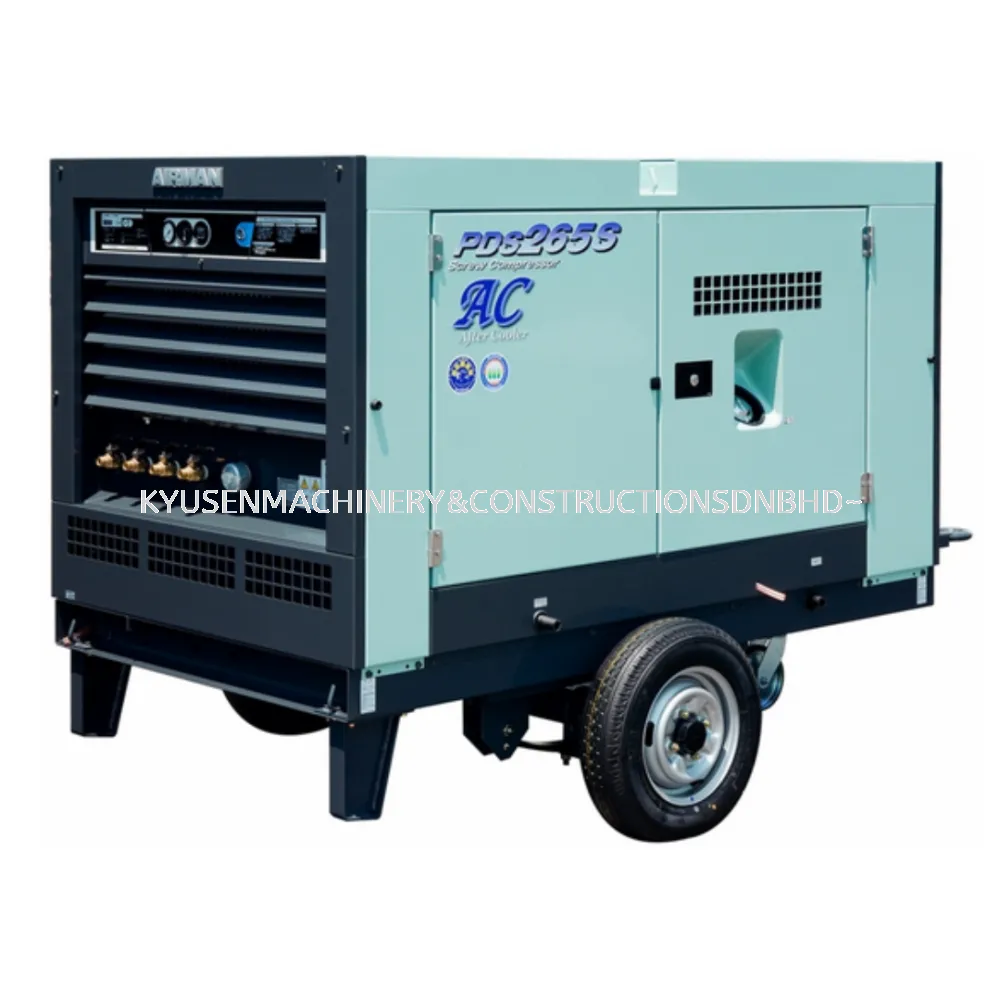
Kyusen lists the PDS265SC-4B2 in its After-Cooler Trailer Series. The catalogue gives 7.5 m³/min free air delivery, 690kPa rated operating pressure and a discharge-air temperature of atmospheric temperature +20°C. These are fields for that named model, not universal aftercooler ratings. Kyusen model reference
The temperature entry expresses a difference above ambient. Illustrative calculation: if ambient air is assumed to be 30°C, the catalogue expression gives 30 + 20 = 50°C. It does not mean the discharged air is fixed at 20°C. This is arithmetic using the published expression, not a site measurement or a guarantee at every operating condition.
That temperature entry also does not specify a pressure dew point, oil limit or particle class. A cooler-air specification alone cannot demonstrate that a moisture-sensitive process will accept the air. Obtain the exact proposed unit’s data sheet and treatment documents before using this catalogue example in a project assessment. The regular portable-series rental comparison is a separate configuration reference, not a treatment guarantee for those models.
Specify moisture at the point where it matters
Pressure dew point (PDP) is the temperature at which water vapour starts condensing at the compressed air’s operating pressure. It describes moisture behaviour, rather than simply how warm the discharge air feels. An atmospheric dew-point reading and a PDP reading at line pressure need their pressure bases identified. Dew-point definition
For a process with a moisture requirement, send the specified limit, pressure basis and acceptance location. Keep maximum air temperature in a separate field. Ask the process owner whether acceptance is at the compressor outlet, after treatment or at the tool/process connection.
Describe the downstream route and its coolest expected conditions. Air can cool further after the compressor, so liquid separation at its outlet does not settle moisture behaviour throughout the line. Ask the supplier to assess whether aftercooling and separation are sufficient or whether a dryer is needed for the specified duty. Downstream moisture discussion
Avoid replacing a written requirement with “dry air.” If the process specification has not been obtained, mark the moisture target as unknown and request clarification. Likewise, an aftercooler label does not establish oil-free or breathing-quality air.
Check treatment capacity under the actual conditions
Parker’s dryer selection guidance uses maximum inlet and ambient temperatures, minimum inlet pressure and maximum flow. Its published flow ratings have reference conditions and correction factors. That is why a headline capacity alone is insufficient for choosing a dryer. Dryer capacity reference, PDF page 2
Send the expected conditions to the supplier and request the assessment for the exact treatment equipment. Ask how its inlet-temperature limit, operating pressure, usable flow and required outlet quality are checked together. Keep flow units and rating bases on both the compressor and treatment documents; ask the supplier to reconcile any difference.
The assessment should also address pressure available at the point of use with the treatment equipment and distribution route included. If a proposed dryer consumes air or needs external power, ask for those requirements in the package scope. Do not apply another manufacturer’s correction table or an assumed pressure-loss allowance to the proposed unit.
Confirm drains, servicing and verification
Condensed liquid needs a working removal path. Donaldson identifies drains and condensate treatment as supporting parts of an air-treatment system. Condensate components
Ask which separator and drain are supplied, who checks and services them, and how collected condensate will be managed on site. Obtain the actual equipment’s operating and maintenance instructions. Agree responsibility for treatment consumables, power or cooling services where needed, and access for servicing.
Before delivery, agree how the specified air quality will be verified, by whom and at which connection. A catalogue photograph, a cooler outlet or the absence of visible droplets is not a recorded acceptance test. Ask for the relevant performance documentation and any agreed commissioning measurements; keep them with the equipment proposal.
For a replacement compressor or treatment component, check the new documents against the same requirement. A machine with similar flow can still have a different treatment configuration.
Turn the requirement into a complete enquiry
Use this worksheet to keep the process requirement and the supplier’s response together. Blank fields indicate information still needed; they are not default specifications.
| Field | Record or request |
|---|---|
| Application | Process/tool model: ___; requirement or manual: ___ |
| Flow and pressure | Flow, units and rating basis: ___; pressure at use: ___ |
| Temperature and moisture | Maximum air temperature: ___; moisture/PDP limit and pressure basis: ___ |
| Other contaminants | Particle and oil limits, with specification: ___ |
| Site conditions | Ambient range: ___; downstream route/layout: ___ |
| Offered package | Compressor, aftercooler, separator/drains, dryer and filters: ___ |
| Acceptance and services | Verification point/method: ___; servicing and required site services: ___ |
Add rental or purchase, location, dates and daily hours. Ask the quotation to distinguish included equipment, optional treatment, delivery, support and current availability. Treat the compressor and air-treatment package as one documented proposal for the stated application.
For the underlying tool schedule and compressor capacity comparison, continue with the portable air compressor selection guide. For supply, request a rental package or discuss purchase, unit condition and inspection. Ask the proposal to identify the actual compressor and each treatment component; neither a catalogue label nor a historical photograph confirms current supply.
Request an air-treatment package for your application
Start with the process, location, dates and rental or purchase requirement. If specified, add flow, pressure, temperature, moisture and contaminant limits with the acceptance point. Ask Kyusen which details are still needed and which treatment components the proposed package includes.
Sources & conditions
References describe their stated configurations and conditions. Confirm the exact unit, accessories and service scope in your quotation.
- Atlas Copco: HD and TD air compressor aftercoolers Description: cooling, condensation and drainage; checked 5 October 2026.
General cooling mechanism. Atlas Copco model capacities and moisture-removal percentages are not specifications for Kyusen's Airman units.
- Kyusen: Airman compressor PDS265SC-4B2 After-Cooler Trailer Series specification and photograph; checked 5 October 2026.
Published model example. Confirm the offered unit's documents, treatment configuration, condition and availability. The listing does not provide a pressure-dew-point guarantee.
- Atlas Copco: Dry compressed air explained — aftercoolers, dryers and dew point Pressure dew point definition and aftercooler function; checked 5 October 2026.
Supports distinguishing discharge temperature, liquid separation and water-vapour control. No generic dew-point target is assigned to a Kyusen application.
- Donaldson: Clean, Reliable Compressed Air — Understanding Key Filtration Stages Particulate, coalescing and activated-carbon filters; supporting condensate components; checked 5 October 2026.
Explains separate contaminant-removal functions. It does not establish that any of these components are included in a Kyusen quotation.
- Parker: StarlettePlus-E Refrigeration Dryers, SPE 010–250 PDF page 2: Product Selection & Correction Factors; checked 5 October 2026.
Shows why dryer capacity must be assessed at the installation's temperature, pressure and flow conditions. Its correction factors and model ratings are not transferred to other equipment.