Portable air compressor selection for construction: compare flow, pressure and the job
Start an Airman compressor rental or purchase enquiry with Kyusen in Puchong by sharing the job, project location and dates. If you have tool manuals, send them so flow can be compared at the required pressure. This guide helps you prepare the brief, compare the documented rental models and confirm the actual unit and package.
Planning a project?
Share the job, location and dates. Add the hire period if renting.
You can enquire before choosing a model. Technical details can follow.
Quick checklist for a rental enquiry
Start with three things: the job and tools, the location and dates, and rental or purchase. For hire, add your proposed period, quantity and daily operating hours if known. Minimum hire and availability are confirmed in the quotation.
The short compressor rental or purchase enquiry lets you choose Not sure yet. Add technical details in WhatsApp afterward; you do not need to guess a capacity to start.
| What you already know | Useful next step |
|---|---|
| The job, but no flow or pressure figures | Start the short enquiry and describe the work. Ask which manuals or process details are needed. |
| Tool models or manuals | Use the tool-demand worksheet to record pressure, consumption and tools working together. |
| A model has been suggested | Compare the documented rental models, then request the offered unit’s documents and condition. |
| The process specifies air temperature, moisture or contaminants | Read the aftercooler and treatment guide and send the actual limits. |
Compare the documented rental models
Kyusen’s existing catalogue references cover the Airman PDS390S-4B1, PDS655S-4B2 and PDS750S-4B1. Their detail pages keep free air delivery, working pressure and configuration limits together. Use the rental-model comparison to shortlist a discussion, then request the actual offered unit’s nameplate, rating sheet and condition photographs.
PDS655-series photographs from a past incoming-stock announcement are separate evidence from the regular PDS655S-4B2 catalogue. DA / Dry Air markings alone do not verify the exact variant or air-treatment performance. Confirm the supplied package before treating two similarly named compressors as equivalent.
Identify the site equipment you actually need
This guide concerns portable air compressors for construction and site maintenance. If your search began with a tyre inflator, workshop compressor or fixed industrial air system, explain that application first. The word portable alone leaves the equipment class unclear.
Tell Kyusen what the compressed air will do: operate a named pneumatic tool, serve a specified cleaning process or meet another documented requirement. Include a model or reference photograph when available. Identify whether the proposed compressor is engine-driven or electric, and what site services it needs.
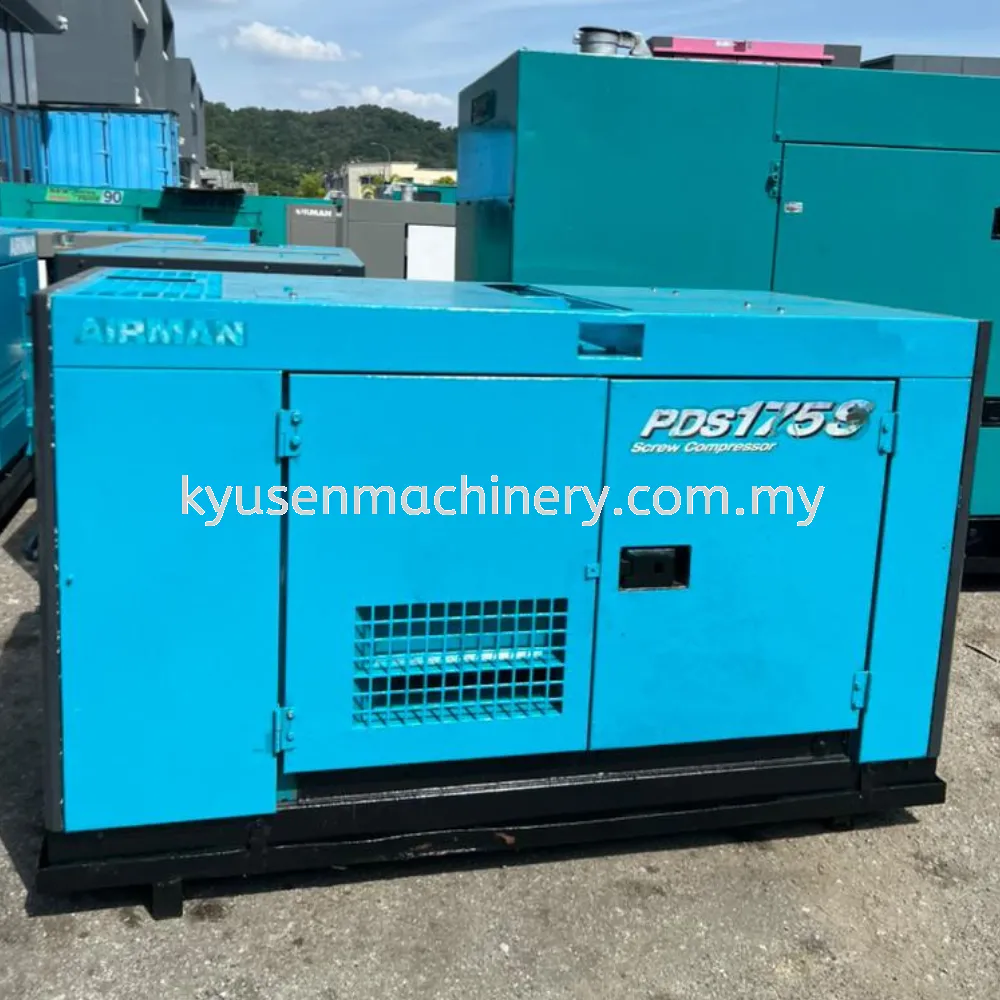
Kyusen’s PDS265SC-4B2 catalogue is an example of a named After-Cooler Trailer Series unit. Its specification distinguishes free air delivery, operating pressure and engine output. It is a separate reference from the compressor photograph above; do not treat either as confirmation of the unit being offered. Kyusen catalogue example
Read air flow and working pressure together
CFM describes air flow in cubic feet per minute; PSI describes pressure. Atlas Copco explains that a compressor’s flow capacity is stated at a pressure, and that flow and pressure are more useful for selection than horsepower alone. Specification reference, page 1
Ask for the proposed unit’s delivered flow at the required working pressure, supported by its data sheet. A large headline flow figure and a maximum-pressure figure, quoted separately, do not answer that question. Ask whether the quoted operating point is supported for the intended use.
Keep the rating label and units with every figure. You may see SCFM, ACFM or free air delivery (FAD), and flow expressed in m³/min instead of CFM. Do not place unlike rating bases in one comparison as though they were identical; ask the supplier to reconcile them. Atlas Copco specifically flags SCFM and ACFM as terms to discuss for the application. Rating terminology
For competing proposals, request the exact model, stated flow basis and pressure on the same worksheet. The Airman rental range guide puts the published figures together. Use those rows as discussion references, then confirm the proposed operating point for your tools and layout.
Build the tool schedule before choosing capacity
Atlas Copco’s mobile-compressor guidance connects capacity selection to the compressed-air consumption of the equipment being supplied. Start with the actual tool manuals, rather than a generic estimate for “one breaker” or “two tools.” Connected-tool demand
Use this enquiry worksheet. Leave an unknown field open and attach the manual or ask for clarification; a blank is more useful than an assumed number.
| Detail | Tool or process A | Tool or process B |
|---|---|---|
| Exact model and manual | ___ | ___ |
| Documented air consumption, units and rating basis | ___ | ___ |
| Required pressure at the tool or process | ___ | ___ |
| Number operating together | ___ | ___ |
| Continuous or intermittent use; expected overlap | ___ | ___ |
Illustrative brief: a contractor plans two pneumatic tools on the same work area. Record each model, its manual’s demand and pressure, and whether both operate at once. Ask the supplier to assess that operating combination and the distribution arrangement. This is an enquiry example, not a completed project or a calculated compressor recommendation.
Explain the longest expected period of simultaneous operation and any process that must keep running. Ask how capacity allowance will be justified for that schedule. There is no universal sizing multiplier in this guide; the proposal must address the documented demand and operating conditions.
State the air-quality requirement separately
An aftercooler cools compressed air so moisture can condense and be drained; Atlas Copco describes this mechanism in its aftercooler guidance. It does not settle every process’s air-quality requirement. Aftercooling reference
Ask the process owner for any specified temperature, moisture, particle or oil limits, including where those limits must be met. Send the specification to the supplier and ask which cooling, separation, drainage, drying or filtration components the proposed package includes.
A listing labelled after-cooler does not by itself confirm dry, oil-free or breathing-quality air. Request evidence for the complete package and the required application. For a sensitive process, identify the acceptance requirement before comparing rental rates. Keep air treatment as a separate line in the equipment proposal so it cannot disappear when a different compressor is substituted.
For the treatment package and a real Airman temperature example, read the air compressor aftercooler guide. If you already have a process specification, send it with a compressor enquiry and ask Kyusen to identify each included treatment component.
Show the delivery route and the hose layout
Send a simple sketch from the intended compressor position to each point of use. Mark approximate hose lengths, branches, connection requirements and any route crossing a working or access area. Ask the supplier to assess the proposed distribution layout against the required pressure at the tools.
Provide photos of the entrance, unloading area and intended working position. Clarify whether the proposal is for a trailer, skid or another mounting arrangement, and how it will be delivered and positioned. “Portable” does not confirm that a unit can be towed on the planned route or moved by the site’s available equipment.
Obtain placement, ventilation, exhaust, clearance and operating restrictions from the actual unit’s manual and the responsible site team. Record the agreed location in the proposal. Confirm hose and coupling specifications through that assessment rather than selecting a universal hose size or clearance from this article.
Compare complete rental or purchase proposals
Bring the tool schedule, air-quality specification and layout together. Add the site location, working dates, daily hours and whether you need rental or purchase. For hire, ask which identified unit can be reserved and what delivery, collection, fuel, accessories and support are included. For purchase, request the actual unit’s condition, inspection arrangements and written service terms.
Ask the response to name the compressor and treatment equipment, document flow at pressure, list the connections and show the quotation scope. Resolve any missing tool data before accepting a sizing recommendation. If a replacement unit is proposed, review its documents and included equipment against the same brief.
For rental, compare the documented models and request an availability check for the proposed dates. For purchase, discuss the offered unit, condition and inspection terms; a rental catalogue entry does not establish sale stock. Keep your worksheet with the proposal so the site team and supplier assess the same job.
Prepare a compressor enquiry with the right details
Start with the job, location, dates and whether you need rental or purchase. If available, add tool manuals, simultaneous use, pressure, air-quality requirements and a hose sketch. Mark missing details as unknown and ask what is needed before a unit can be proposed.
Sources & conditions
References describe their stated configurations and conditions. Confirm the exact unit, accessories and service scope in your quotation.
- Atlas Copco: Most Common Air Compressor Specifications Page 1: CFM, PSI, HP and flow-rating terminology; checked 5 October 2026.
General specification guidance. It does not establish the performance of a particular Airman or Kyusen unit.
- Atlas Copco: Diesel-powered mobile air compressors Selection discussion: capacity, pressure and connected tools; checked 5 October 2026.
Supports assessing connected equipment demand. Use the actual tool manuals and proposed compressor data sheet for sizing.
- Atlas Copco: HD and TD air compressor aftercoolers Description: cooling, condensation and drainage; checked 5 October 2026.
General explanation of aftercooling. Published Atlas Copco performance figures are not transferred to Kyusen's equipment.
- Kyusen: Airman compressor PDS265SC-4B2 After-Cooler Trailer Series listing and specification headings; checked 5 October 2026.
An example of a model-specific catalogue entry, not confirmation of current stock, hire availability or the supplied unit's condition.